
What exactly is a logline, a beat sheet and story cards? How to use them, and why.
WHAT THEY ARE FOR
A screenwriter’s job comes down to six types of document, and the creative discussions that go into creating each. Known as development materials, these documents serve two functions:
WRITING
Writers use some, or all, as creative tools to move a story through the writing process – known as a script pipeline, or just ‘development’. This can be with a writing team, partner or alone. Producers often refer to these documents as steps (stages) in a screenwriting contract – then they are called ‘deliverables’.
PITCHING
Writers use many of these documents to pitch a story to producers or financiers, often incorporating them into visual presentations to make pitch decks. While this often occurs after a script is finished, the development process still has a long way to go.
Part 1 introduces the first three: logline, beat sheet, and story cards/index cards. For Treatment, Screenplay and Notes, read Part 2.
1. THE LOGLINE
WHAT IT IS…
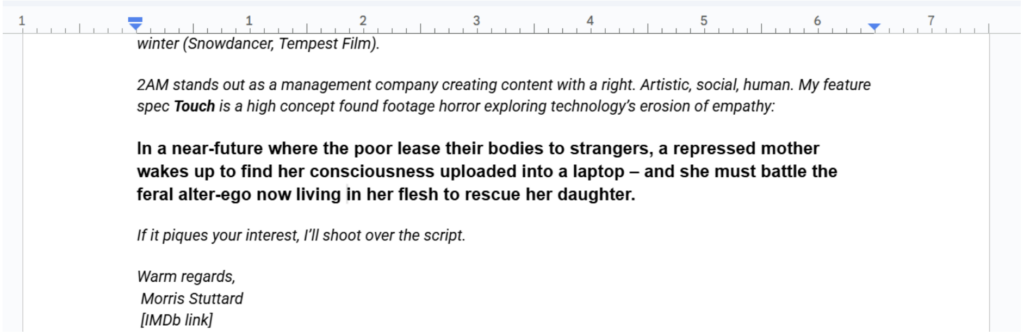
The logline is not a document, but rather a microcosm story summary which acts as a TLDR for the script. We drop loglines into the top of longer development documents, into query emails when seeking representation, in grant applications or just conversation – at the beginning of an elevator pitch, for example. A logline is a one-to-two sentence description of your screenplay, and is expected to convey the following information, even if implied rather than stated:
- Who the story is about (not their names)
- Where and when the story is set (if setting is special)
- What the protagonist wants
- What is the conflict
- What the stakes are
WHY USE IT…
A logline is an excellent starting point for your story. If you have a logline that makes other people excited, this is an excellent sign that your story has value. Stick it on your computer while you work – it will help guide your creative decisions along the way.
Loglines are more commonly associated with pitching, however. They are the industry standard for communicating your story to film industry people with no time or effort.
They are the industry standard for communicating your story to film industry people with no time or effort.
WHAT MAKES A GOOD LOGLINE
“No…effort” is important – a good logline should be written so clearly that the story jumps into the listener/reader’s imagination even when their mind is elsewhere. The overall best thing for a good logline is a good story.
WHAT CAN GO WRONG
- You call it a longline.
- It is too long. Keep it to one sentence across 2 lines if possible.
- You are writing a non-classic narrative script for festivals, and it is almost impossible to convey the story in 2 lines. Go longer.
- You don’t understand your story well enough yet to write a logline. A good story can be found almost any idea – the hard thing is to see the story within the story.
5. BEAT SHEET OUTLINE
WHAT IT IS…
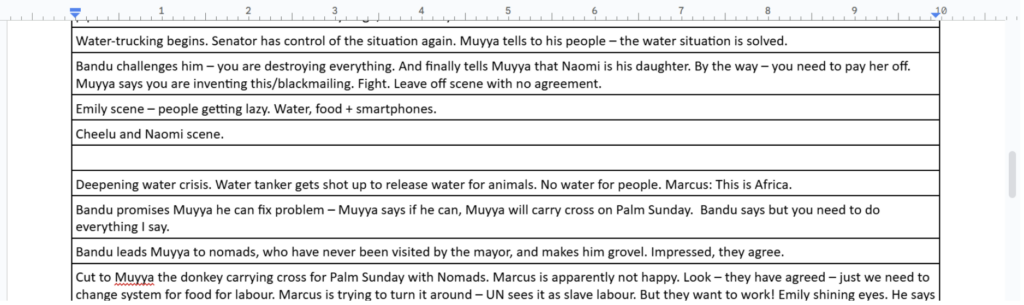
A working document used to create a film story by organising it into ‘beats’ (scenes). At the beginning you may only have five or six events that you know will happen in your story. After writing down the five, you will have more ideas to include. The goal is to have around 60 in total, amounting to 3-4 pages of A4.
If a producer wants to be hands-on in the development process, a beat sheet outline can be the first deliverable they ask you to submit.
WHY USE IT…
An instrument for planning your story. The beat format allows you to insert new ideas between beats, and move them around where necessary, all the while expanding your story. It is succinct, flexible and intuitive – a useful story structure tool, which grows in usefulness as a writer grows in skill.
WHAT MAKES A GOOD BEAT SHEET
A good story told in quick, punchy language.
WHAT CAN GO WRONG
- Beats become half a page long.
- Prosaic. This is not the place for ornate descriptions.
- Almost inevitable for novice writers: the story fails in one of the six million ways a story can fail.
6. STORY CARDS/INDEX CARDS/SLIDES
WHAT ARE THEY
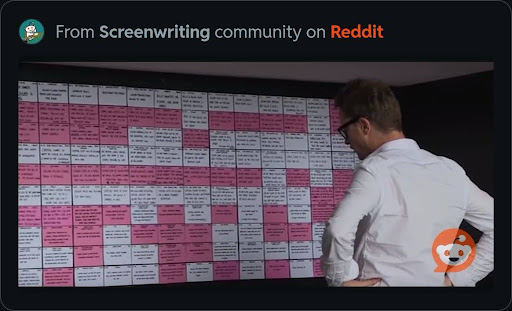
A visual display of story cards can help you develop structure, character and pacing. Each card describes one scene in your film. For a feature, your aim is to create 50-70 cards. They will be physical cards you stick on a board, or a mirror (you’re a screenwriter – you don’t need good looks until after you make the film) – or they can be slides in a presentation.
On each card, you write 15-25 words on:
- Location of the scene (e.g., EXT. GARDEN – ROSE FLOWER)
- Character(s) in the scene
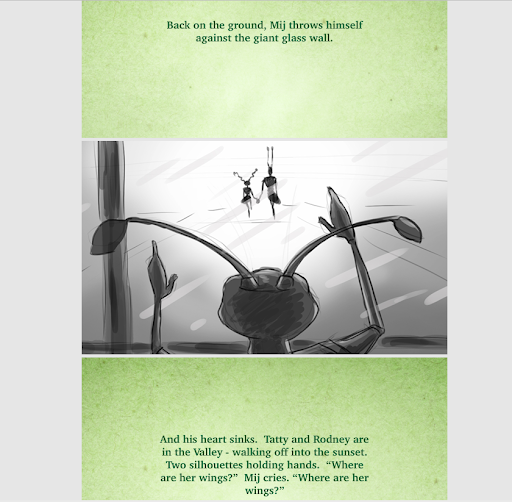
- What they DO – focus on agency, conflict and emotional significance. (e.g., The aphids think Mij is here to eat them. Mij convinces them he is a friend. Touched by his story, they agree to help).
Each card describes one scene in your film.
WHY USE THEM
As a development tool: Cards are a method for turning a beat sheet outline into a functioning story. They are even more useful for planning a season in a series. Once the cards are up, examine the story as a whole and use all your dramatical abilities to elevate the story through discussion, revision and reorganisation. Do not stop until you feel the story functions as well as you can make it without developing it in longer form. Do not take down the cards until you down tools for the project – the cards will act as a visual story reference tool as you write and rewrite the script.
Some people create index cards before a beat sheet, but the best way is usually the longest – so do a beat sheet, then do the cards, then redo the beat sheet in preparation for the treatment.
As a pitching tool: You can also use the cards technique to pitch a fully developed story, even when the script is done. Using computer-based slides for pitching a story is nothing more than a modern day version of the card pitches given in Hollywood until recently. Pitching with slides is very common in animation – where each card is visualised with artwork and the writer narrates the story verbally.
WHAT MAKES A GOOD STORY CARDS
In development:
- Physical cards on a wall/cupboard/mirror instead of on a computer screen – if you want to use your spatial brain for story structure, feed it physical content. (*BUT use electronic slides for pitching).
- Instead of index cards, use sheets of coloured card that you cut up and code according to the drama, action or plotline of each scene. This allows you to get a handle on the dramatic pacing of the story work.
- Cards whose size represents screen time. If you know a scene will take up five minutes of your film, use a long rectangular card, while a bit scene (short) can be represented by a letterbox shape.
In pitching:
- Combine with excellent artwork.
- Use captions, not passages, or killer lines from the dialogue. If you are telling the story out loud as they look at images, keep text to a bare minimum – you want them to be listening not reading.
WHAT CAN GO WRONG
- Combine with excellent artwork.
- Use captions, not passages, or killer lines from the dialogue. If you are telling the story out loud as they look at images, keep text to a bare minimum – you want them to be listening not reading.
END NOTE: FILM, ANIMATION, TV, OR SHORT FILMS?
The format of script development documents stay mostly the same whether you are pitching for a sale, seeking a hire, applying for a screenwriting grant, or hard at work on a TV series.
There is some variation in format when moving from feature film to TV/episodic – and animation uses more visuals – but these documents are used by all screenwriters across all types of screenwriting.
WHAT ABOUT SHORT FILMS?
Since a finished short film is usually the first thing the industry sees rather than the script, development documents are more to guide the creative process than to pitch for new partners. Nevertheless, these tools exist because they help you craft a story – it is highly recommended to use some or all of the documents when developing your short film script, and working through a development pipeline is great practice for your screenwriting career.
See: TREATMENT, SCRIPT & NOTES: SCRIPT DEVELOPMENT DOCUMENTS — PART 2